
The Johnson Criteria: Precision in Thermal Imaging Science
How do we scientifically define if a thermal imager is "good enough" for a specific task? The answer lies in the widely accepted standard used by the engineering community: The Johnson Criteria.
Mantas Jonas Marcinkevičius
12/3/20252 min read
How It Works in Practice
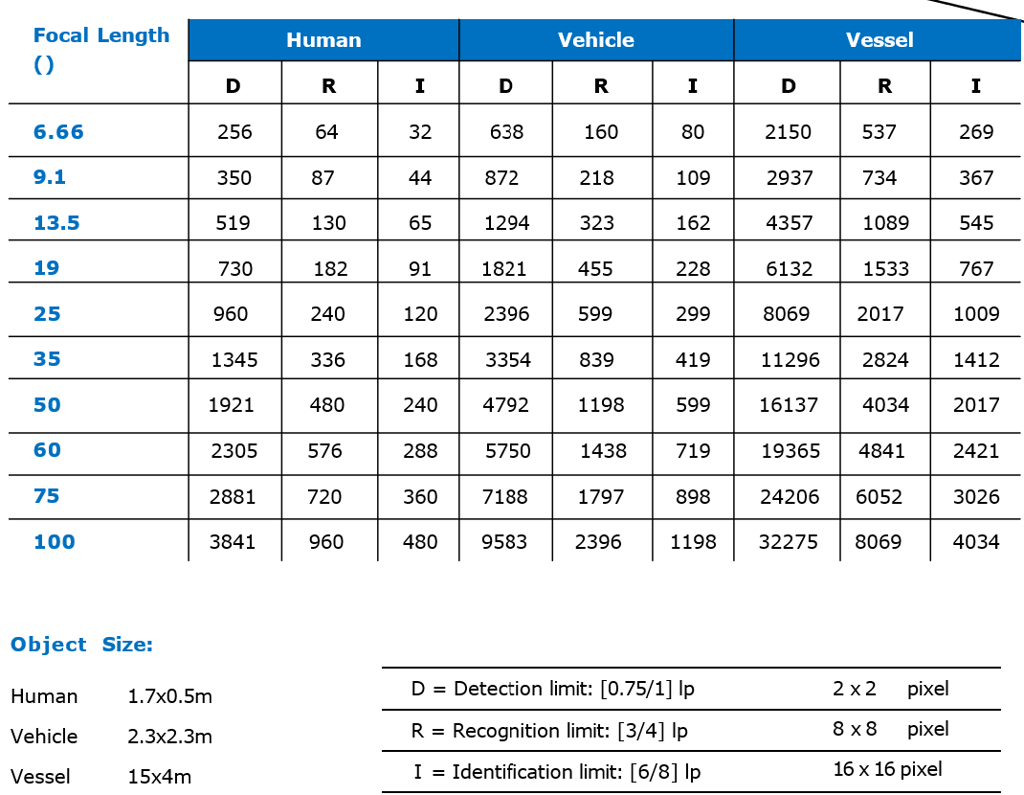
Practically, by using a table like the one provided, we can immediately see the vast performance difference based on the chosen Focal Length:
Shorter Focal Length (e.g., 6.66mm): Provides a wide Field of View (FoV), excellent for close-range Detection tasks.
Longer Focal Length (e.g., 100mm): Offers a narrower FoV but much higher magnification, allowing Identification to be achieved at significantly greater distances. For instance, the detection range for a human with the 6.66mm lens is 256m, while with the 100mm lens, it extends to 3841. Sadly, you would have to compromise in compact size, but in exchange you gain a massive, nearly 15-fold range difference!
What Are the Johnson Criteria?
In 1958, US Army engineer John Johnson developed an empirical model that successfully linked a camera's performance to the human operator's ability to successfully execute specific observational tasks. These criteria define how many horizontal line pairs (lp/h – line pairs per height) must fall across a target (a human, a vehicle, or a vessel) to achieve a corresponding level of discrimination:
Detection (D): Is something present in the scene?
This typically requires about 0.75lp/h (as indicated in the provided table by 0.75/1lp per pixel). This represents the minimum definition of the object's presence.
Recognition (R): Do we know what the object is (a human, a car, a boat)?
This demands higher resolution, usually ranging from 3 to 8 lp/h. The table suggests an 8 x 8 pixel constraint for this level.
Identification (I): Can we discern a specific type of the object (e.g., male/female, a particular car model, friend or foe)?
This is the highest level, requiring the finest resolution, often 6 to 16 lp/h or more. The table suggests a 16 x 16 pixel constraint.
Accuracy Over Speculation
The Johnson Criteria are vital in the design process, allowing engineers and procurement professionals to select the correct lens (ranging from 6.66mm to 100mm and sensor based on the required combination of range and task level (D, R, or I). This ensures that the thermal imaging system is not just "good," but precisely meets specific operational requirements, shifting surveillance from the realm of guesswork to provable engineering reality.
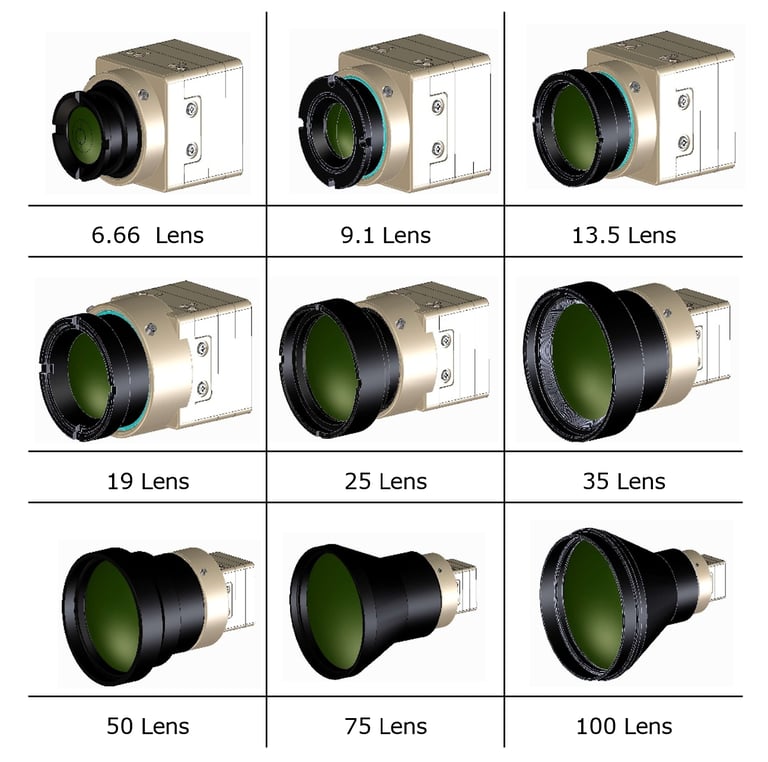
The AIVT series cameras come fully equipped with the entire lens suite—from 6.66mm to 100mm—allowing you to confidently meet precise Johnson Criteria levels at any operational distance.